
Yes, we know it’s 2019 and Skibbereen Arts Festival will celebrate its 10th anniversary this year. Every year since its inception, the festival committee celebrates the arts in Skibbereen through a street art project. This street wall mural project completed in advance of the 2018 festival celebrates many of these heritage links and Skibbereen Tidy Towns was delighted to nominate this very special project for the Heritage award. We’ll have to wait until September for an announcement but in the meantime, with approval from Skibbereen Arts Festival (thanks Brendan!), thought we would post the details here for our readers to enjoy.
A lot of time was spent in choosing the walls that would suit the size and content of the historical figures. Considerable assistance from Skibbereen Heritage Centre provided the project with the necessary historical detail. A talented artist, also a native of Skibbereen, Jack Field, worked for over a week on the murals. Since their creation they have proved to be of immense interest to visitors, local people and schoolchildren.
Here are their stories…
Denis O’Sullivan (1868-1908) – Location: Town Hall
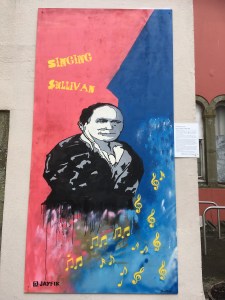 Denis O’Sullivan was born in San Francisco in 1868, the son of Skibbereen emigrants.
His father, Cornelius D. O’Sullivan, was born in Skibbereen in 1820. He emigrated to America in 1845, just on the eve of the Great Irish Famine. His mother, Mary Ann Sullivan, was also from Skibbereen.
Known as the ‘Singing Sullivan’, Denis became a world-renowned baritone and actor. In 1901, the ‘London Times’ pronounced him to be “one of the illustrious singers of the world.”
Denis O’Sullivan never forgot Skibbereen. At the height of his career, when he was filling many of the most famous Grand Old Opera Houses and theatres in Britain and America, he still found time to make his way to Skibbereen. For five consecutive years, the famous baritone and actor made his way ‘home’ and gave recitals at the Town Hall with the entire proceeds going to the local branch of the St Vincent de Paul Society.
Denis O’Sullivan was regarded as the foremost authority on Irish music in the world. He was the adjudicator of the Feis Coil, was vocalist, delegate and speaker to the Pan-Celtic congress in Dublin and was a delegate to the Irish national convention in1907.
In 1909 a bust of Denis O’Sullivan was added to the collection at the National Gallery of Ireland in Dublin.
Dr Dan Donovan (1807-1877) – Location: Medical Centre
Dr Daniel Donovan – the Famine Doctor – did more than anyone else to help the poor people of Skibbereen and to highlight their pitiful suffering and destitution during the Great Irish Famine (1845-52).
Born in Rosscarbery in 1807, Dr Dan spent most of his medical career in Skibbereen.As medical officer in Glandore and Union Hall (1830 to 1839), Dr Donovan had all the resources of his medical expertise and resilience tested to the full during the cholera epidemic of 1832-34. The young doctor was not found wanting and his exertions on behalf of the local people were widely acknowledged.
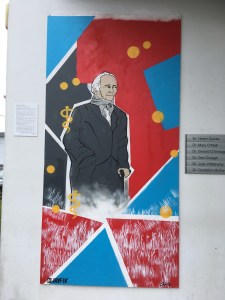 However, it is for his extraordinary work on behalf of the wretched poor of the Skibbereen Union area during the Great Famine that he is best remembered.
Dr Dan was regarded as one of the most authentic and reliable commentators on the Famine and disease. His ‘Diary of a Dispensary Doctor’, which was published in ‘The Cork Southern Reporter’ in 1846 and 47 was quoted in other newspapers in Ireland, Britain and America. He also wrote in many of the top medical journals of the time.
The ‘Dublin Medical Press’ said of him:
“It was owing to his heroic and great exertions during the terrible crisis of 1847 that his name has become a household word for pure philanthropy and most earnest and unselfish devotion to the poor when famine and pestilence swept over Ireland. … All the resources of his intellect, all the energies of his mind were devoted with the most self-sacrificing zeal and courage, grappling with disease in its most dangerous type, and fighting bravely in the glorious cause of suffering humanity.”
Jeremiah O’Donovan Rossa (1831-1915) – Location: Levis’ Quay
Jeremiah O’Donovan Rossa was the most legendary member of the Fenian movement in Ireland in the second half of the 19th century. He the most valiant Fenian of them all, the man the English couldn’t subdue. Rossa held a very special place in the hearts and minds of nationalist Ireland.
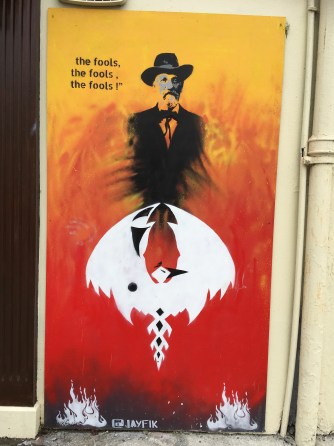 Rossa was born in Rosscarbery in September 1831. Having had a very comfortable childhood, his life changed completely at the beginning of the Famine in 1845. In a short space of time he witnessed the three great evils of famine – his family was evicted from their property; his father died working on one of the infamous public works scheme, and his whole family emigrated to Philadelphia while he came to live with an aunt in Skibbereen.
Rossa lived in Skibbereen during the Famine and witnessed first-hand the horrors of disease and death on an enormous scale in the worst affected parts of Ireland.
In 1856, Rossa and other like-minded men founded one such organisation The Phoenix National and Literary Society in Skibbereen. Out of this spread the Fenian movement in Ireland.
Without a doubt, Patrick Pearse’s famous oration at Rossa’s funeral in Dublin on August 1, 1915, was a pivotal moment in the emergence of the new generation in the struggle for Irish independence and it helped to set in motion a series of events that led inexorably to the 1916 Rising and the subsequent War of Independence.
Mick McCarthy (1965-1998) – Location: Fields car park gable wall facing west
Mick McCarthy captained the O’Donovan Rossa GAA Club, Skibbereen, to county, Munster and All-Ireland senior football titles in 1992-93.
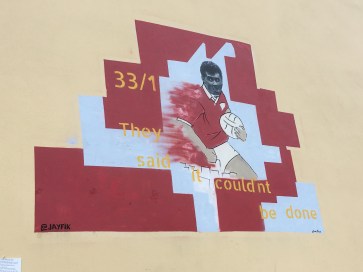 From the age of eight, when ‘Small Mick’ won his first SW championship medal, he lit up the Gaelic football fields in West Cork and beyond. He went on to win just about every honour there is in Gaelic football. Among his seven All-Ireland medals were three U21 All-Ireland titles with Cork and All-Ireland senior football championship titles in 1989 and 1990. He captained Cork in their 1993 All-Ireland defeat by Derry.
Mick’s proudest sporting achievements were undoubtedly captaining his beloved Rossas to county, Munster and All-Ireland senior football titles, leading by example all the way with some extraordinary individual displays in crucial games.
Mick was held in the highest regard and with the greatest respect by everyone, on and off the field, and his tragic and untimely death at such an early age in 1998 robbed his family and Skibbereen of one of the great sportsmen in the town’s history.
Agnes Mary Clerke (1842-1907) – Location: Fairfield car park gable wall facing west
Agnes Mary Clerke was born in Bridge Street, Skibbereen, on February 10, 1842. Agnes, and her sister Ellen, were home educated and were brought to an academic level which was unusual for women of that generation. They were taught modern languages and music by masters but were never sent to school. The family moved to Dublin in 1861 and they later lived in Florence and London.
Agnes was, from her childhood, interested in astronomy. She wrote several books on the subject and went on to become one of the leading chroniclers of astrophysics and astronomy throughout the latter part of the 19th century.
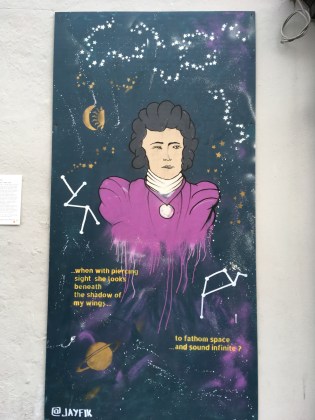 Agnes made a tremendous impact on in the science of astronomy and cosmology and for a quarter of a century she was the leading commentator on astronomy and astrophysics in the English-speaking world.
Her most famous book, ‘A Popular History of Astronomy During the Nineteenth Century’, published in 1885, is still being reprinted. She wrote other important books, including ‘The System of the Stars’ (1890), and ‘Problems in Astrophysics’ (1903), and she also wrote 150 biographical entries in the original volumes of the ‘Dictionary of National Biography’.
The Clerke Crater on the moon, close to the eastern edge of the Sea of Tranquility, is named after Agnes.
Ellen Mary Clerke (1840-1906) – Location: Bridge Street
Ellen Mary Clerke was born in Bridge Street, Skibbereen, on September 26, 1840. Like her sister Agnes, Ellen never had any formal education, being educated at home by her parents and some tutors.
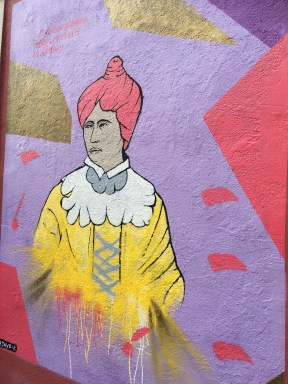 A brilliant litterateur, Ellen became an accomplished author and published works in several European languages. Probably her most famous work is ‘Fable and Song in Italy’. She was also a recognised scientific journalist, specialising in geography and anthropology. She won wide recognition for a major article on the Dock labourers strike of 1889.
Ellen joined the permanent staff of the influential Catholic weekly newspaper, ‘The Tablet’, in the mid-1880s, which she also helped to edit, and she was highly regarded as a commentator on Italian and German politics.
On astronomy, Ellen contributed occasionally to the ‘Observatory’ magazine and to the ‘Journal of the British Astronomical Association’.
Ellen also ventured into fiction and published a novel, ‘Flowers of Fire’.
For regular updates please subscribe to this blog and follow up on Facebook or Twitter.
Featured image courtesy of http://www.skibbereenartsfestival.com
 Skibbereen Tidy Towns